Homework and a Reminder: Your 3-2-1-R is due Sunday by 8PM. On Tuesday you will have a mini-mental inventory on global warming and climate change. Review your notes and handouts. This will be a way for me to see what you have retained about climate change and global warming.
Saturday, September 29, 2012
The science behind a climate headline
Today we discussed what makes a source credible. We compared the two editorials you read for the info lit assignment and you had to defend an article's credibility. At the end of class we watched the four minute TED talk on The Science Behind a Climate Headline.
Homework and a Reminder: Your 3-2-1-R is due Sunday by 8PM. On Tuesday you will have a mini-mental inventory on global warming and climate change. Review your notes and handouts. This will be a way for me to see what you have retained about climate change and global warming.
Homework and a Reminder: Your 3-2-1-R is due Sunday by 8PM. On Tuesday you will have a mini-mental inventory on global warming and climate change. Review your notes and handouts. This will be a way for me to see what you have retained about climate change and global warming.

Friday, September 28, 2012
Owl Pellet and Energy Pyramid Recap
Today we recapped the owl pellet lab and made connections with what we saw and how energy moves through an ecosystem. We emphasized that no energy transformation can be 100% complete because much of what an organism eats is used to keep the organism alive. What isn't used for growth, reproduction, daily activities etc., can also be lost as heat.
Homework: Your info lit on climate change is due tomorrow.
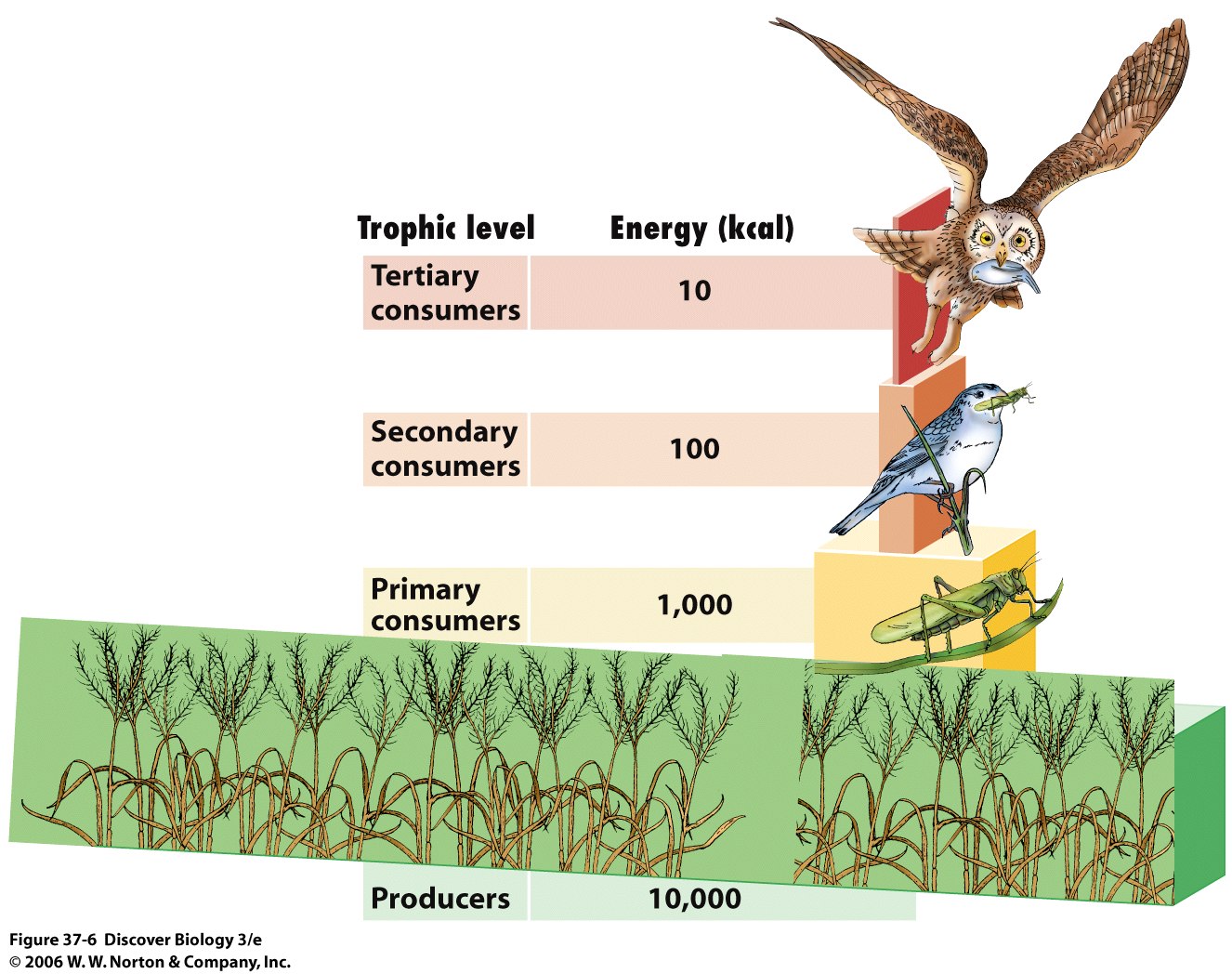 |
| http://www.csus.edu/indiv/l/loom/wk%2014/energy%20pyramid.jpg |
Thursday, September 27, 2012
Owl Pellet Dissection
Today students dissected owl pellets. We found voles, mice and even a pocket gopher! Below is a picture of a skull and mandibles that Kobe found. Can you figure out what animal this belonged to?


So what was the point of this lab? We were able to see how no energy transfer is 100% complete as we move up through the trophic levels. Consider the cow pictured below. How much energy is actually left in its tissues out of the 100kJ it consumes?
There's only 4kJ left in the cow's tissue! So here's something to think about, based on the picture above and what you know about mass meat production: Why do people say that a vegetarian diet is more eco-friendly? Here's a story from Radio Boston about what it takes to make your meat.
Homework: Your info lit packet is due on Saturday.
Wednesday, September 26, 2012
Info Literature
Yesterday we met with Mrs. Harding, from the Bunn Library, who spoke with us on how to critically assess where our sources of information on the internet come from. On Saturday you need to turn in the completed Info Lit packet that you received in class.
On Thursday we will be getting an up close and personal look at just how matter is transferred through the food chain.
On Thursday we will be getting an up close and personal look at just how matter is transferred through the food chain.
Saturday, September 22, 2012
Mental Inventory
Today you had your first major assessment of the year on photosynthesis, energy and the scientific method.
Homework: You have a 3-2-1-R due on Sunday by 8PM and you need to finish the post lab questions for 'testing a hypothesis.' I will collect the testing a hypothesis questions at the start of class on Tuesday.
Homework: You have a 3-2-1-R due on Sunday by 8PM and you need to finish the post lab questions for 'testing a hypothesis.' I will collect the testing a hypothesis questions at the start of class on Tuesday.
Friday, September 21, 2012
Global Warming Day 2
Today we revisited global warming and climate change. Our two main questions for today were:
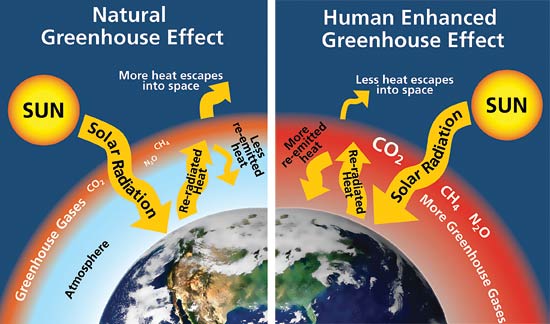
1. How does an increase in carbon dioxide lead to an increase in global temperature?
Solar radiation hits the Earth and some of it is absorbed and some is reflected back into space. Carbon dioxide is a greenhouse gas which means that it re-reflects this energy back to the Earth.
This reflection back to Earth can lead warmer temperatures. As the oceans get warmer, more ice melts, as more ice melts, there is less ice to reflect the light away from the Earth, as more....well, you get the idea.
This is an example of a positive feedback loop.
2. What are the impacts of a change in temperature on living things?
Here's the list of things you came up with in class to answer this question:
* As temperature increases, it pushes on the zones of tolerance of organisms. This can impact their niche.
* Changes in temperature can impact migration patters of organims
* Tangle food webs but putting stress on areas that weren't stressed before --> boom and bust of populations
* Impact geography (ice melt)
Homework: Study for your mental inventory tomorrow!
1. How does an increase in carbon dioxide lead to an increase in global temperature?
Solar radiation hits the Earth and some of it is absorbed and some is reflected back into space. Carbon dioxide is a greenhouse gas which means that it re-reflects this energy back to the Earth.
 |
| Image from: http://www.nps.gov/goga/naturescience/images/Greenhouse-effect.jpg |
This reflection back to Earth can lead warmer temperatures. As the oceans get warmer, more ice melts, as more ice melts, there is less ice to reflect the light away from the Earth, as more....well, you get the idea.
 |
| image from: http://www.350resources.org.uk/wp-content/uploads/2008/11/iceposfeedbacksmall2.jpg |
2. What are the impacts of a change in temperature on living things?
Here's the list of things you came up with in class to answer this question:
* As temperature increases, it pushes on the zones of tolerance of organisms. This can impact their niche.
* Changes in temperature can impact migration patters of organims
* Tangle food webs but putting stress on areas that weren't stressed before --> boom and bust of populations
* Impact geography (ice melt)
Homework: Study for your mental inventory tomorrow!
Thursday, September 20, 2012
Testing a hypothesis
Today we tested your hypothesis about plankton in the pond. On September 17th, you submitted the following:
THIS IS OUR HYPOTHESIS (PERIOD E).
We could test the amount of plankton in shady areas and sunny areas to determine if the shade makes a difference on the photosynthetic phytoplankton and the zooplankton that eat the phytoplankton.
So, our hypothesis is…
If the amount of shade increases, then the amount of plankton in that area will decrease because the phytoplankton need sun to photosynthesize and the zooplankton stay where the phytoplankton are so they can eat the phytoplankton.
Below is the data we collected, because we needed to share the waders, we didn't get to sample site three (you also have a link to the data in your email).

The post lab questions are due in class on Tuesday.
THIS IS OUR HYPOTHESIS (PERIOD E).
We could test the amount of plankton in shady areas and sunny areas to determine if the shade makes a difference on the photosynthetic phytoplankton and the zooplankton that eat the phytoplankton.
So, our hypothesis is…
If the amount of shade increases, then the amount of plankton in that area will decrease because the phytoplankton need sun to photosynthesize and the zooplankton stay where the phytoplankton are so they can eat the phytoplankton.
Below is the data we collected, because we needed to share the waders, we didn't get to sample site three (you also have a link to the data in your email).

Subscribe to:
Posts (Atom)